
Thursday, October 05, 2023
STATUE OF LIMITATIONS
Looks like it's time (south of the border) to bring out the statue and let the pigeons and crows enjoy themseleves


Monday, May 22, 2023


Wednesday, May 10, 2023
CARPAL TUNNEL
If it isn't one thing, it's another. I've been waiting for months for an appointment with a physician who's supposed to operate on my carpal tunnel. No call. Meanwhile, things in my right hand have gotten worse. Pain and numbness and I can hardly use my right for anything (and I'm right-handed). Ever buttoned your shirt with only your "other" hand, or signed your name with that hand?
Come on, Doc, get in there and open that tunnel for me.
Thursday, March 30, 2023


Monday, March 27, 2023
JIMNASTICS #7
Click on the image to enlarge
 Where's My Ride?
 Self Portrait
 We're All In This Together
 Come Dance With Me II
 Stack Of Heads
 Well Rooted
 Is That A Fly?


JIMNASTICS #6
Click on the image to enlarge
 Plant in the studio
 Come Dance With Me
 Neighbor's Tree
 Trying TO find My Ancestry


Sunday, March 26, 2023
JIMNASTICS #5
Image will enlarge when you click on it


 I started titling at this point: "High-Tech is big on our planet"


Saturday, March 25, 2023
JIMNASTICS #4


Friday, March 24, 2023


MORE JIMNASTICS


Thursday, March 23, 2023
RETIREMENT
/>
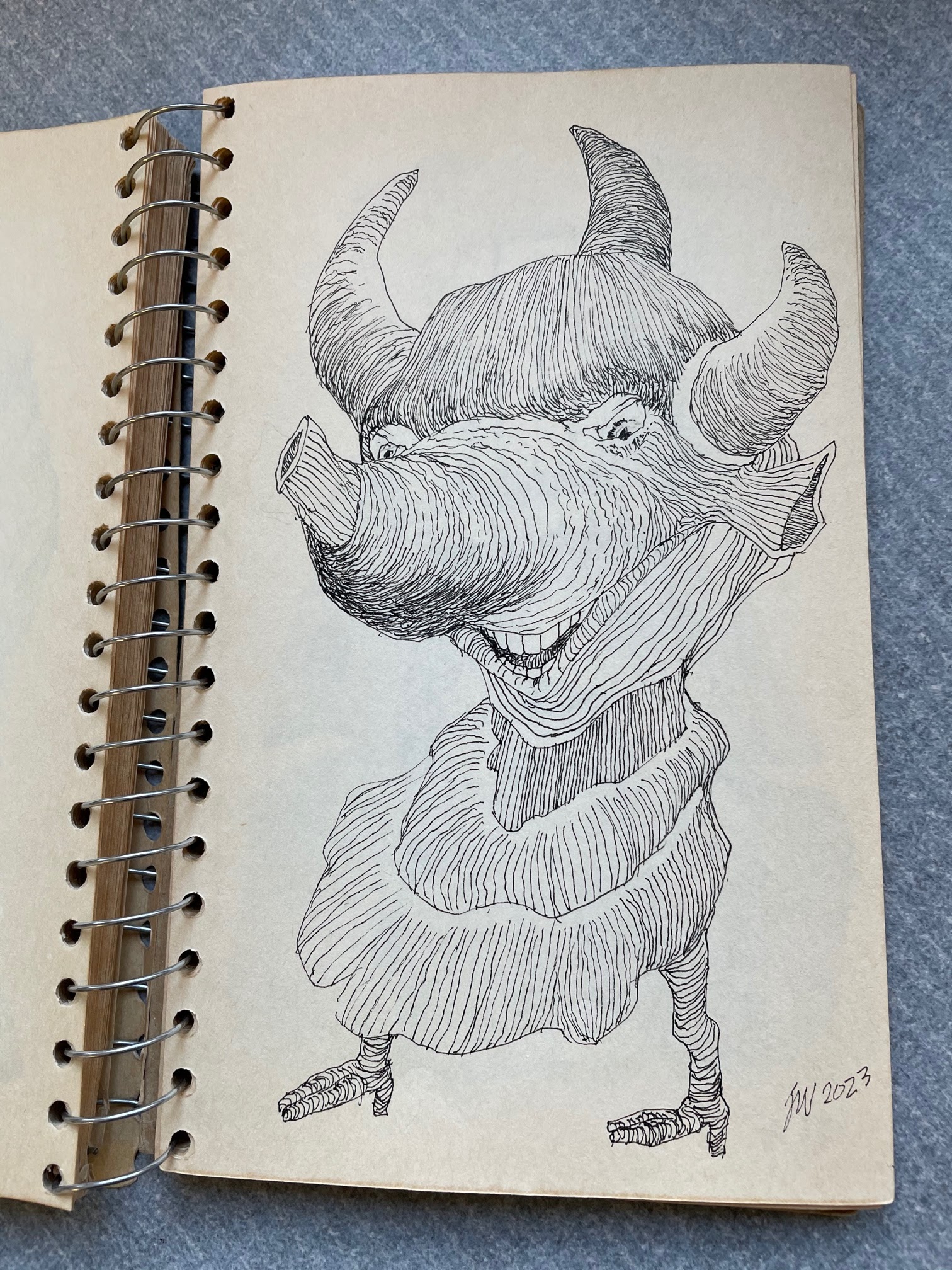
AS MY AGING CARCASS BECOMES MORE DIFFICULT TO NAVIGATE AND CONTROL, INCLUDING A CARPAL TUNNEL SYNDROME, THE ABILITY TO ENGRAVE WOOD AND OPERATE THE PRESS HAS ENDED FOR ME. IN OTHER WORDS I'VE RETIRED FROM WOOD ENGRAVING. AT THE BEGINNING OF THIS RETIREMENT IT WAS DEPRESSING AND I MISSED GOING TO THE STUDIO. MY SON KURT ENCOURAGED ME TO GET OUT THERE AND DRAW, SO I DECIDED TO TAKE HIS ADVICE AND AFTER AN HOUR OR SO I COULD SEE THAT THIS WOULD BE THE ANSWER. I GUESS I HAD BEEN MORE ATTATCHED TO WOOD ENGRAVING THAN I THOUGHT. I OPENED AN OLD SMALL SKETCHBOOK I HAD AND BEGAN BY SITTING AND STARING AT THE BLANK PAGE, WITH NO IDEA IN MIND. I TOOK MY PEN IN MY RIGHT HAND (THE BLOCKED CARCASS HAND) AND MADE SOME RANDOM LINES AND MARKS AROUND THE PAGE, WITH NOTHING IN MIND. AFTER A WHILE THERE WAS QUITE A NUMBER OF THE MARKS AND I NOTICED A POSSIBLE FORM. I TOOK OFF WITH IT AND FINISHED THE SKETCH. MY HAND DIDN'T ACHE SO I TURNED THE PAGE AND STARTED ANOTHER THE SAME WAY, AND THAT'S THE METHOD I'VE BEEN USING.
IT'S BEEN OVER A MONTH NOW AND I'VE FINISHED 31 DRAWINGS. HERE'S A FEW, IF YOU CLICK ON THE IMAGE IT WILL ENLARGE:


Sunday, July 17, 2022
DEMON III LEARNS FROM DEMON II

Saturday, November 13, 2021
GERRY HAT TRICKS
I overheard some people, who seemed to be in my generation, talking the other day and I heard one of them talking about where they were going for an appointment. They said they were going to "Gerry hat tricks". Now that's a new one on me. At first I thought it was maybe the name of a doctor: Gerry Hattricks. Then I thought maybe they were bored and were going to some place called Gerry's to play a game called hat tricks.
Maybe I should look into this to see if I can improve my aging carcass with some hat-trick games.
Try this: Take the three words, gerry, hat and tricks, and put them together as one word: "gerryhattricks" and say it outloud. What did you hear?
Sunday, October 24, 2021
PLURAL VERSION OF A WORD
Words of single items and words for more than one of those items are often not the same words. For instance a single page in a book is a page but more than one page are pages (just one simple example).
I was thinking about the word goose and how the sound of that word, for the plural, was changed more than the addition of an s at the end.
If the plural of goose is geese, why isn’t the plural of moose “meese”?
The word goose existed in the Anglo-Saxon language for centuries and had, back then, been given the plural version. But the word moose was only in the English language in the 1600s because the Anglo-Saxons didn’t know it existed until then. The word moose was from the Abenaki language in North America.
This got me thinking of a way to bring this into a wood engraving and the result was to bring two geese and two moose together withe same spelling rule. I'm engraving a block which will be printed and titled "TWO GEESE RIDING TWO MEESE"?
I have engraved this block to a a point where I have printed the first proof and when it was dry I scanned it. Here's a copy. 
As I've mentioned in previous pages of the blog, my studio work has slowed dramatically. I have added years to my carcass and that has come at a price. (edition of 30 print size: 7 X 5 in.) $100.00 Click on the image to get a larger view

As I've mentioned in previous pages of the blog, my studio work has slowed dramatically. I have added years to my carcass and that has come at a price. (edition of 30 print size: 7 X 5 in.) $100.00 Click on the image to get a larger view
Wednesday, July 28, 2021
ODDBALLS
Another series that was printed as a book (both limited edition by me and by Porcupines Quill) was ODDBALLS. If you click on this link then click on "Preview This Book", you can then scroll down to "Table of Contents and clidk on a name of an ODDBALL to see the wood engraving. The sequence of texts/titles and images in this link may be off.
 "The Mad Trapper" wood engraving

Tuesday, July 27, 2021
ALTERNATIVE TO THE WEBSITE
I thought I'd put some links on my Blog that would bring up some of my work that was on my website that was shut down by TELUS. I'll start with the Porcupines Quill. The publisher of my "See What I'm Saying?" book:
Click on "See What I'm Saying?" title then on that opening page click on "preview this book". When you scroll down you will see a list of the titles of the work in that series. Each is linked to an image. I know,it's complicated, but it's the best I could do.
 "Fly Fiahing" wood engraving

Saturday, July 17, 2021
TIMES THEY ARE A'CHANGIN' BIG TIME
I suppose this title links to my entries a few times back, but this one today has nothing to do with the pandemic. Two weeks ago I tripped and fell and had to be taken to the hospital. They found my hip had to be repaired.
Well the operation was a week and 6 days ago and yesterday I was discharged. I thought it was too soon because I was having so much trouble moving around. I'm facing the changing times of moving around the house (instead of laying in a hospital bed). Moving on the main floor only (can't go down the basement) so, I'll need to arrange some help. Not easy to get to the studio either.
Tuesday, June 29, 2021
BIG OF THREE SISTERS
My friend Dave invited me to join him on a road trip from Red Deer to the Rockies, around Canmore, Alberta. The destination was an area where there are three peaks next to each other. They are called The Three Sisters. The largest peak on one end is called the Big Sister. Next to that is Middle Sister, then Little Sister. I was captivated by them and when we returned from our trip I began to make sketches from the photos I took and check on the internet for some other views. Big of Three Sisters is the result.
 BIG OF THREE SISTERS @ wood engraving (ed.25) image 7 x 5 in. $100.00 (you can click on it to enlarge)

Wednesday, March 31, 2021
ROOTS TO LIMBS TO LOGS
Last Sunday I got my act together, after I had finished making changes on the block, and inked up the press and got it going. By mid-afternoon I had an edition of 25 of "Roots To Limbs To Logs". It's from a 5 X 7 inch block and a relatively (for me) small edition. I just don't have the stamina or energy for more, as more and more of the years pile up. Not to mention: a larger edition would require being hung on the wires near the ceiting on hooks to dry. It means I would have to climb a ladder to hang each one. My balance and stability in that position is now very risky.
 ROOTS TO LIMBS TO LOGS © wood engraving (ed.25) image: 7 x 5 in. $100.00
(You can click on it to enlarge)
ROOTS TO LIMBS TO LOGS © wood engraving (ed.25) image: 7 x 5 in. $100.00
(You can click on it to enlarge)

Tuesday, March 23, 2021
ROOTS TO LIMBS TO LOGS
Back in late January or early February I was forcing myself to get into the studio and get my mind off my aching back and my gloom-and-doom thoughts. I got the sketchbook out and tried to focus on it. I started pushing my pen around the paper and letting one line lead me to another without any idea or image in mind. Before long I began to see that the lines were following a linking pattern similar to the growth of roots and I picked that up and followed it. As I was integrating roots and limbs into what I already had on the paper, I started to think beyond a tree. I saw a link between the life of a tree and the life of all living things. Roots to limbs to logs.


Saturday, February 06, 2021
A WOOD ENGRAVING IN CHANGIN' TIMES
After the struggle to get things moving in the studio again, it's here at last. The new Alien of Planet Earth, Wolf Spider.
 WOLF SPIDER © wood engraving (ed.18) image: 5 x 7 in. $100.00
(You can click on the image to enlarger it)
WOLF SPIDER © wood engraving (ed.18) image: 5 x 7 in. $100.00
(You can click on the image to enlarger it)

Thursday, February 04, 2021
TIMES THEY ARE A CHANGIN'
Times are changing, as Bob Dylan said in the lyrics of his song. The restrictions brought on due to the COVID pandemic have certainly reinforced that. My work in the studio has slowed to a crawl and my ambition and motivation have slipped nearly out of sight. I'd like to share with you how it has been for me.
I have been finding moments, here and there, to do some sketches of "Aliens of Planet Earth". Eventually I decided to try a wolf spider, a unique species with excellent eyesight. The reason for the good eyesight is that they have eight eyes! So the series of sketches began, until I arrived at one I wanted to engrave. I drew it on a block and began to engrave. When I reached a point where I thought a proof was needed I printed one.
I knew that, with my inacivity and lack of regular axercise, I didn't have the ability clean the press without wearing me out. So I inked the block with a hand roller, then printed it on the press. I was able to get a fair idea of what it would look like and scanned the proof when it was dry so I could use the computer prints to try out different alternatives by drawing on them.
I finally reached a decision to print an edition. I started this morning and finished this afternoon. I knew that printing an edition the size I usually print was a bit over my ability to handle now and press clean-up would be a task that would take a lot out of me. So I ran a small edition. My most recent edition, Poodle Moth, was an edition of 33. Wolf Spider is an edition of 18.
When the prints are dry I'll scan one and share it with you here.
Tuesday, December 01, 2020
PANDEMIC:


Tuesday, November 24, 2020
UP AND AT 'EM!
I've been out in the studio each day trying to focus on an idea to turn into a wood engraving. Most of the time there are only thoughts going through my head about the tough times, aches and pains and the boredom of isolation. But the other day the words dancing through my head stumbled a bit and got me headed in the "See What I'm Saying?" direction. I opened my "inkubator" (sketchbook) and started to put some images together to convert the words to a visual state. When I had it together and took a break, then came back later to see if there was any more I could do to it, I was confronted with an image that I found boring. (This is a common incident and part of the process.) So I kept pushing and pushing to see if I could come up with something else. Since the word relationships idea I had come up with was a dud, I turned my thoughts to the "Aliens of Planet Earth" and I've got some ideas I'm going to chase down.
When I Have an image worked out I'll open the "inkubator" and let you have a peak.
Tuesday, November 10, 2020
THAT'S ENOUGH

Subscribe to:
Posts (Atom)